$24.95/mo.
300 Mbps
$35/mo.
133 – 415 Mbps
$35/mo.
300 Mbps*
25–150Mbps
What does a city that once built ships on a wartime schedule expect from its internet? Richmond sits on the East Bay shoreline with about 115,000 residents. The city is home to a Chevron refinery and a working port still anchoring the economy. The household profile explains most of what follows: a median income near $95,000, a per-capita figure under $44,000, and nearly half of all homes occupied by renters. Those numbers describe crowded households making careful decisions about monthly bills.
When it comes to broadband, the practical map is more layered than the city's size suggests.
Xfinity internet reaches roughly 99 percent of addresses by most counts, which makes cable the default from Point Richmond to Hilltop.
Fiber internet by AT&T, EarthLink and Sonic form the faster symmetrical layer, though fiber arrives block by block, and EarthLink sells service over another operator's network instead of building its own.
Renters who relocate often turn to 5G fixed wireless options by T-Mobile, Verizon, EarthLink and AT&T, gateways that move with the household.
Starlink and Viasat cover the hillside and shoreline gaps that wires skip.
What's worth noting is the competitive shift beneath the marketing. Older coaxial and copper lines still lie under newer glass like strata, so a Marina Bay condo and an Iron Triangle apartment a few miles apart can reach different layers.
As Sonic and AT&T overlap across more of the city, cable's long unchallenged position is giving way to a contest over price and upload speed.
366.10 Mbps
94.95 Mbps
10 ms
16
Average speed rate as per Ookla’s Speedtest results for 2026
Enter your zip code to get a list of top internet providers serving your neighborhood. Compare speeds, prices, features, and plans, and select the best option for your home.
Fiber is the newest layer in Richmond's connectivity history, arriving block by block, so two addresses in Marina Bay or near Point Richmond can have different options. Symmetrical speeds hold steady through foggy mornings and windy afternoons, and latency stays low for video calls.
Best for:Cable reaches nearly every Richmond address and remains the default in older apartment blocks across the Iron Triangle and Santa Fe. Downloads are strong, though uploads trail fiber and evening congestion can appear on shared neighborhood lines.
Best for:5G home internet suits a city where moving is routine: the gateway plugs in and travels with the tenant. Performance depends on line of sight to the nearest tower, so hillier streets reward a trial period before committing.
Best for:Across Richmond, connection choice tracks housing more than income. Apartments along Cutting Boulevard and in the Iron Triangle lean on wired and 5G gateways, while the hillier streets near Hilltop produce the widest swings in wireless signal. A household with approx. 3 people, the citywide average, usually runs several screens at once, so upload speed matters more than the headline download figure.
Streets where wired options thin out, particularly near the shoreline industrial districts, are where wireless and satellite earn their place.
Recent developments point the same direction. Richmond has pursued public Wi-Fi before, including a 2011 network aimed at Iron Triangle residents and a later city and school district plan for central Richmond, and the California LifeLine Home Broadband Pilot now offers qualifying households up to $20 a month toward broadband, or up to $30 bundled with voice.
For renters, who make up nearly half of the city, that subsidy plus no-contract wireless plans turn a lease change from a reconnect problem into a routine errand. That mix of public programs and portable plans narrows the gap between tenants and homeowners.
Richmond sits inside AT&T's wireline territory, so AT&T Internet is the natural first check, offering symmetrical multi-gig service with no data caps or annual contract wherever it has been built. Sonic Fiber competes directly, with symmetrical speeds up to 10 Gbps and free installation. EarthLink Fiber markets service over third-party fiber, so its reach tracks the host network. Newer fiber builds are still expanding, so an address check matters more than any citywide claim.
Xfinity internet remains the broadest wired network in Richmond, with plans advertised up to 2 Gbps and wide availability. Its strength is reach and bundle flexibility. Its limit is upload speed, which trails fiber, and evening congestion on shared neighborhood lines can soften performance.
T-Mobile 5G leads on reach and flat monthly pricing, while Verizon 5G Home Internet deserves an address check because its coverage is patchier by some estimates. AT&T Internet Air suits households already in AT&T's orbit, and EarthLink 5G Home Internet resells wireless service with similar tradeoffs. Fixed wireless operators Unwired and Etheric Networks also serve parts of the East Bay.
$50/mo.
300 Mbps
Price + taxes & fees for new customers after discounts w/elig AutoPay & Paperless bill. Ltd. avail/areas.
$45/mo.
300 Mbps
For 60 mos., no term contract. Taxes and fees extra. Incl. up to $10/mo. auto-pay & paperless bill discount. See Broadband Facts: https://www.xfinity.com/broadband-labels
$35/mo.
133 – 415 Mbps
w/AutoPay and a voice line. Plus taxes and fees.
Richmond's speed needs divide along work and housing lines more than along income. The city mixes Bay Area commuters, refinery and port employees, healthcare workers tied to Kaiser Permanente's Richmond medical center, and large multigenerational households. It's easy to see why no single tier fits everyone. Evening demand, when schools, streaming and video calls overlap, is the real test of any connection.
A software engineer working remotely from a Marina Bay condo needs symmetrical fiber for video calls and large uploads, which points to AT&T Fiber or Sonic Fiber. A port or refinery worker in a four-person apartment near Hilltop needs steady evening streaming across several screens, where Xfinity internet or a gateway such as T-Mobile 5G performs well. A renter in a building fiber has not reached may do best with a portable gateway and no contract
Matching speed to the household, rather than to the largest advertised number, tends to settle the decision quickly, and an address-level check confirms which options actually reach the door.
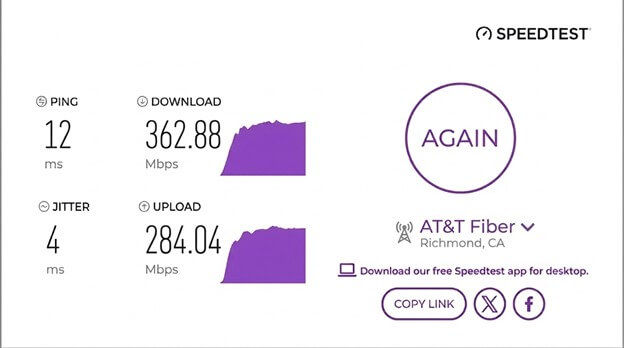
A verified speed test from an AT&T user in Richmond, CA, shows strong results. Download speeds are plenty for 4K streaming, remote work, and many devices at once. Upload speeds handle video calls and file sharing well. Latency of just 12 ms keeps gaming and live calls smooth and jitter-free.
See How Fast Your Connection Really IsFlexible Plans for Richmond Renters
Richmond's median gross rent of $1,960 a month leaves little room for an oversized internet bill. While you can't control inflation, you can save by choosing cheaper internet plans in Richmond.
AT&T Fiber carries no data caps, no annual contract, and the gateway is included, which removes the equipment fees that quietly raise many cable bills. Households on qualifying assistance programs can also apply for AT&T's Access discount.
Xfinity offers Internet Essentials for households that qualify for public assistance, a practical option in the many Richmond apartments where cable is the only wired choice. Promotional pricing runs for a limited period, so note when the rate resets.
T-Mobile 5G Home Internet keeps pricing simple with one flat monthly rate, no annual contract, and no installation visit, which suits renters moving between leases. Speeds vary by tower distance, so trial the gateway before relying on it.
Pro-Tip: Residents of ZIP codes 94801 and 94804 who qualify for California LifeLine can apply the Home Broadband Pilot subsidy or bundle with voice for a better quote. Plans must meet a 100/20 Mbps minimum, and provider participation varies, so confirm before switching. A prepaid cellular plan such as Mint Mobile's can bridge a gap between leases.
At LocalCableDeals, the goal is to make choosing a provider in Richmond a more orderly exercise. The team built free, easy-to-use tools that narrow the field to a plan fitting your address, household, and budget within minutes.
Place AT&T Fiber or Xfinity side by side for a Richmond address and see how speed, price, and contract terms differ. The comparison helps renters weigh shorter commitments against promotional rates that reset.
Compare ProvidersDescribe the household, whether a four-person apartment near Hilltop, a Marina Bay home office, or a studio in the Iron Triangle, and the builder suggests a speed tier and connection type to match, rather than the largest number on offer, and avoids paying headroom the household will never use.
Build a PlanCheck if your current Richmond provider is delivering the promised download and upload speeds to meet your household or home office needs by running a quick test.
Test my SpeedBrowse internet options, speeds, and coverage in other cities of California to get a complete picture.
Yes, in many areas, but availability depends on your address. AT&T Fiber and Sonic Fiber are key options, with speeds up to 10 Gbps from Sonic. EarthLink Fiber is also available in some areas through third-party networks. Check your address to confirm service availability.
AT&T Fiber and 5G home internet plans often have low starting prices, with Xfinity also worth comparing. Sonic Fiber may cost more upfront but offers free installation. Compare regular rates after promotions, equipment fees, and discounts through California LifeLine or provider assistance programs.
T-Mobile 5G Home Internet and Verizon 5G Home Internet are flexible options that typically require no technician visit and can move with you. Renters with fiber access can consider AT&T Fiber, which has no annual contract. Check your lease for provider restrictions before signing up.
Eligible households can explore California LifeLine, which offers broadband discounts through participating providers. Xfinity Internet Essentials and AT&T Access also offer lower-cost plans for qualifying households. Check eligibility requirements and current benefits before applying.
Give us a call. We'll help you find the right answers.
(855) 771-3154Available Monday through Sunday, 24 Hours a Day.
All trademarks belong to their respective owners and are used for informational purposes only. This website uses Microsoft Clarity to understand user interactions and improve products and advertising.
© Copyright 2026 LocalCableDeals. Powered by ibex. All rights reserved.
View our Privacy Policy.


 Provider Comparison
 Plan Builder
 Speed Test