$24.95/mo.
300 Mbps
$35/mo.
300 Mbps*
$49.95/mo.
400 Mbps
$39.99/mo.
100 Mbps
25–150Mbps
As home to some of the biggest tech companies comprising the Silicon Hills, Austin offers residents wide access to high-speed fiber internet at lower pricing than many other areas. This is primarily due to the tough competition among top names in the broadband market, each pushing to offer the best value.
But since internet providers build their networks differently across town, options available for a home in East Austin might be completely different from those in Hyde Park or Round Rock. To help you sort through it, we break down Austin’s top internet providers, so you can easily find a fast, reliable connection that fits your budget and requirements.
Getting the best internet in Austin requires mapping the local infrastructure to see which provider actually delivers the fastest, most reliable connection at your specific address.
If your household depends on heavy data, fiber-optic lines are the baseline choice. AT&T Fiber covers 53% of Austin with no data caps and stable, contract-free internet with up to 5 Gbps speed.
EarthLink Fiber scales the same infrastructure as a highly reliable alternative, offering symmetrical speeds for heavy uploaders. Other high-speed options specific to various neighborhoods in Austin include Astound Broadband powered by Grande, Optimum, and Google Fiber, even though their reach is quite limited at the moment.
If fiber hasn't rolled down your street yet, cable and 5G networks become your next best options. Spectrum serves as Austin’s primary internet provider, commanding almost 93% of local coverage. It provides residents and renters with a quick fallback up to 2 Gbps (in select markets) of multi-gig speeds.
For a more flexible and drill-free setup that skips apartment wiring constraints entirely, wireless internet from Verizon 5G Home offers a simple alternative. Not to mention AT&T Air with its unlimited data and no annual contracts.
As you move into the rocky limestone terrain of the western suburbs, the wireline frequently falls short. Satellite internet bridges this gap. Starlink uses advanced low-Earth orbit arrays to deliver low-latency internet connections for suburban smart homes.
On the other hand, Hughesnet and Viasat supply dependable data that ensures steady connectivity far beyond the edge of the city. However, the cost of satellite connections may convince the user to look for other available options whenever possible.
365.98 Mbps
100.73 Mbps
12 ms
21
Average speed rate as per Ookla’s Speedtest results for 2026
Enter your zip code to get a complete list of internet providers serving your neighborhood. Compare speeds, prices, features, and plans, and select the best option for your home.
Fiber internet uses light signals through dedicated fiber-optic cables to provide high-speed internet to your home. Apart from reliability, symmetrical speeds ensure minimum lag in servers in the Silicon Hills. However, some older neighborhoods in Central Austin are still on the waitlist for fiber connectivity.
Best for:Cable internet connects your home through the same copper wire network that originally brought cable television to the Lone Star State. Its massive coverage is the reason why it’s a top choice for most residents and renters, even though it may lead to slight slowdowns when the network traffic increases in the evening.
Best for:Fixed wireless converts localized cellular tower frequencies into a high-speed wireless internet connection. While it guarantees zero complex hookups and scheduling hassles, the performance is mainly dependent on your physical location. It may degrade if there’s dense construction blocking the cellular path.
Best for:Austin has a famous, unique vibe. But to keep up with its growth, the city now needs a massive amount of internet bandwidth.
Big tech names like Tesla, Apple, and Oracle are moving in. Because of this, Austin is now the fastest-growing data center market in the region. To keep everyone connected, local internet infrastructure has to grow fast.
Companies like AT&T, Google Fiber, and Astound Broadband are constantly expanding their high-speed networks. At the same time, state grants are helping build stronger regional networks. Austin also uses a shared fiber-optic network called GAATN (Greater Austin Area Telecommunications Network). It connects local schools, universities, and city offices so they can share resources and save money. The city even uses this advanced tech for "Smart City" projects, like using sensors and data to make traffic smoother and streets safer.
But Austin isn't just focusing on big tech. The city wants to make sure everyone has internet access. In fact, Austin was named a 2025 Visionary Digital Inclusion Trailblazer for treating high-speed internet like a public utility.
Austin achieves this through great teamwork. For example, a program called Unlocking the Connection teams up with Google Fiber to give free internet to thousands of people living in public housing. Another program gives free high-speed internet to local non-profits and community centers.
By balancing big business growth with community care, Austin is making sure no resident gets left behind in the digital age.
When reliability cannot be compromised, this fiber provider stands out as one of the best options for Austin residents. Apart from its symmetrical speeds, AT&T Internet is also preferred because it includes a modem with its plans. Plus, it offers sub-10 ms latency, making it well-suited for Austin’s increasingly connected households.
Spectrum is the go-to choice for widespread availability and for anyone looking to bundle their mobile and internet, since it offers a free unlimited mobile line for one year. It serves as a highly reliable connection where fiber has yet to be laid. It delivers fast download speeds that easily handle everyday household streaming and casual browsing.
Verizon 5G Home Internet cuts the physical cord entirely, offering a modern approach to home internet with up to a 3-year price guarantee. It is highly optimized for casual users who don’t need more than 300 Mbps speeds. It also caters to minimalists who favor a rapid DIY setup and no equipment fee. For those within strong coverage zones, it presents a strong alternative to traditional broadband.
$35/mo.
300 Mbps*
w/ Auto Pay & any Verizon mobile phone plan .
*Typical speeds of 85-250 Mbps
$30/mo.
100 Mbps
For 1 year. for terms and conditions.
$35/mo.
300 Mbps
For 12 mos. Price + taxes & fees for new customers in select households after discounts w/ elig AutoPay & Paperless bill. Limited availability/areas.
See Broadband Facts: www.att.com/dapbbfacts
Austin’s digital landscape is as diverse as its residents. For power users, gamers, heavy streamers, programmers, and other professionals whose daily work and entertainment rely on massive data transfers, pure fiber is non-negotiable.
AT&T Fiber and EarthLink Fiber deliver symmetrical speeds to handle such data-intensive households. GFiber acts as a low-profile alternative, known for its consistent rates and good customer service.
Yet, widespread geographic reach remains a significant hurdle for fiber expansion, which leaves older residential sectors and East Austin to favor immediate availability over symmetrical speeds.
In such neighborhoods, Spectrum fills the gap. It provides a contract-free, dependable connection with fast download speeds, particularly appealing to households looking to bundle internet with other services like mobile or TV under an uncomplicated bill.
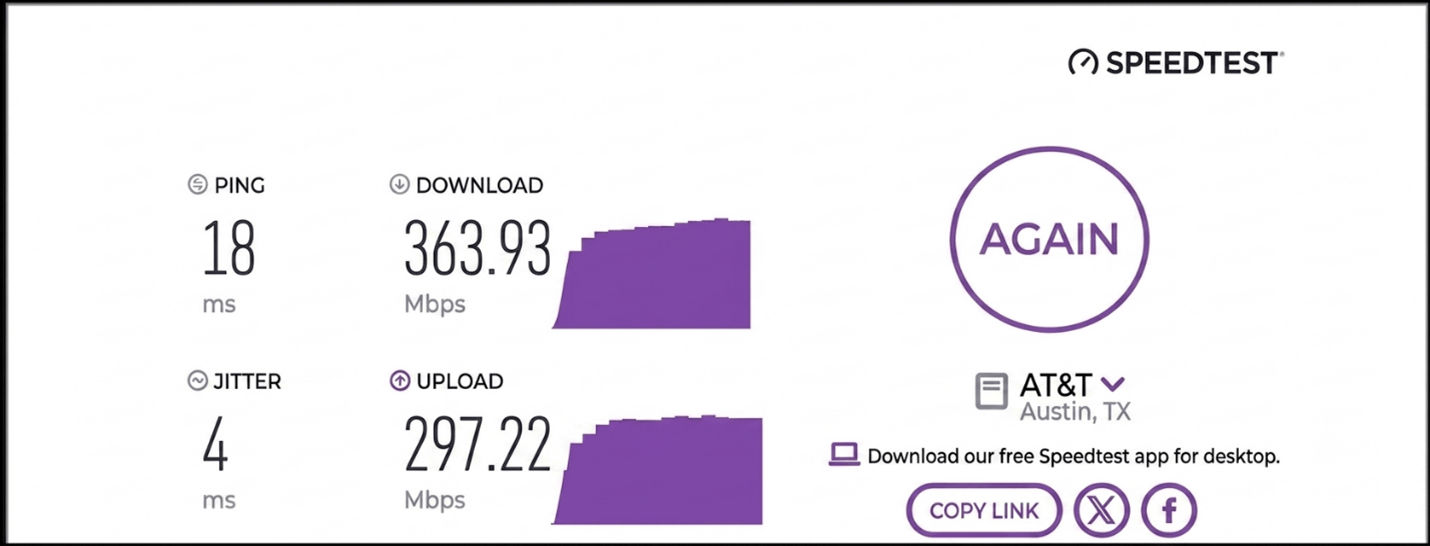
A verified speed test result from an AT&T user in Austin, TX, shows strong download speeds that are more than enough for 4K streaming, remote work, and multiple devices running at the same time. Ping stays lower than 20, making AT&T Fiber a reliable option for multitasking across Austin households.
See How Fast Your Connection Really IsLow-Cost Options for a Budget-Friendly Lifestyle
Austin’s housing market and general cost of living continues to increase since new tech giants have become a part of the city’s infrastructure. It is now increasingly important for families to find relief in their monthly budgets. Fortunately, keeping your home connected doesn’t have to drain your wallet. Finding a balance in this fast-growing tech economy is all about avoiding unnecessary multi-gigabit packages and looking for options with the absolute lowest cost per megabit.
For Central Texas residents cutting utility costs, this network offers widely available, contract-free internet and cheap mobile bundles. The provider also offers discounted internet service for qualifying low-income customers through the Spectrum Internet Assist program.
EarthLink offers highly competitive, budget-friendly plans across Austin. Its lower-tier options are exceptionally well-suited for solo remote workers and light-streaming households seeking an alternative to cable internet.
This wireless solution has emerged as a competitive low-cost option in Austin, offering discounts for existing cellular subscribers. The entire setup is DIY, saving you from mandatory technician visit charges and strict structural drilling permissions. When paired with an eligible mobile line, its multi-year price locks deliver financial predictability for the local market.
Pro-Tip: For low-income Austin households on SNAP, Medicaid, or SSI, local programs like Spectrum Internet Assist offer discounted, reliable high-speed plans for school, remote work, busy households, and telehealth. Additionally, if you live in subsidized housing through the Housing Authority of the City of Austin (HACA), you may qualify for local digital inclusion programs that provide free or ultra-low-cost broadband access.
Our goal at LocalCableDeals is to make your search for the ideal internet provider a breeze. Our team has developed FREE, easy-to-use tools to help you find the perfect plan for your needs within minutes.
Measure Austin's leading broadband options side-by-side. From pure-fiber providers to flexible wireless alternatives, this tool lets you filter through hidden data caps and true monthly pricing. Secure a plan optimized for Central Texas's hyper-competitive tech market.
Compare ProvidersAustin's rapid structural expansion means internet availability varies drastically according to neighborhoods. Our Plan Builder cross-references your exact location against active local networks to construct a suitable connectivity package.
Build a PlanRun a quick diagnostic to discover if your current Austin connection is actually delivering the speeds you pay for. Verify your real-time network stability to ensure your home network can effortlessly handle continuous usage of bandwidth without a single hiccup.
Test my SpeedBrowse internet options, speeds, and coverage in other cities of Texas to get a complete picture.
If you measure bragging rights by pure bandwidth, GFiber stands tall with up to 8 Gbps of symmetrical speeds. However, keeping in mind better geographic reach with realistic high-speed internet access, AT&T Fiber remains the most renowned provider across Austin.
The most strategic path to a cheap internet choice in Austin is avoiding physical line installation entirely. Verizon 5G Home Internet offers incredible upfront value by cutting out router rentals and additional surcharges. For areas dependent on wired grids, Spectrum delivers the lowest pricing for hybrid fiber-coaxial internet without forcing you into long-term contracts.
No, fiber isn't everywhere just yet, though coverage is growing fast. If you live in newer developments or tech-heavy areas like North Austin and Mueller, you have excellent access to gigabit fiber networks. However, many older residential neighborhoods still rely primarily on high-speed HFC networks. Spectrum is usually the primary alternative in such instances.
Give us a call. We'll help you find the right answers.
(855) 771-3154Available Monday through Sunday, 24 Hours a Day.
All trademarks belong to their respective owners and are used for informational purposes only. This website uses Microsoft Clarity to understand user interactions and improve products and advertising.
© Copyright 2026 LocalCableDeals. Powered by ibex. All rights reserved.
View our Privacy Policy.




















 Provider Comparison
 Plan Builder
 Speed Test