$30/mo.
300 Mbps
$35/mo.
300 Mbps*
$24.95/mo.
300 Mbps
$39.99/mo.
100 Mbps
25–150Mbps
After an hour on the subway, the last thing you want is a spinning buffer wheel. NYC households are dense and multi-device, relying on a mix of modern fiber infrastructure, legacy coaxial networks, and older building wiring that varies significantly from one neighborhood to another. That’s why one block gets 5 Gbps while the next craters during the cable congestion spike.
Don't buy generic provider promises. Your building matters more than your borough, especially if the old plaster-and-steel mesh walls are actively eating your Wi-Fi signal.
Whether you’re a Manhattan hybrid worker needing symmetrical fiber upload speeds, a student dodging long-term contracts, or a family in the Bronx looking for enough bandwidth to cater to multiple devices at a time, this guide cuts through the noise. We match real budgets with the connection your address actually supports.
Choosing an internet setup in New York requires looking past the glossy provider billboards and focusing on pure utility. For the tech professional or hybrid worker whose income depends on real-time data transfers, opting for a shared cable line is a massive operational risk.
Verizon Fios represents this group with its 100% fiber-optic network, which offers symmetrical speeds. That dedicated architecture eliminates the neighborhood congestion that routinely kills traditional cable lines when your entire building gets home and turns on Netflix.
The equation also changes for New York's massive transient population, including students and short-term renters who change places annually. For these residents, locking into a long-term contract is a financial trap, making flexible cable providers the practical choice.
Spectrum’s up-to-2 Gbps (in select markets) multi-gig speeds (in select markets) work well for temporary spaces, while Optimum Internet offers a reliable alternative for those wanting a longer structural runway with no data caps. Both infrastructures cover vast territories, require zero annual commitments, and allow for immediate setup.
In apartments where physical access is restricted or internal wiring is outdated, fixed wireless serves as a workaround. Relying on AT&T Internet Air, Verizon 5G Home, or EarthLink 5G allows a tenant to completely avoid old copper lines. All three options offer no-contract plans, though their actual efficiency is entirely dependent on how close the apartment is to the nearest cellular tower.
Lastly, for the far-flung industrial areas and waterfront dead zones without physical lines, satellite connectivity becomes the only viable option. Starlink addresses traditional satellite latency issues from low-Earth orbit, while legacy providers like Viasat and Hughesnet ensure that even the most geographically isolated properties maintain a functional link to the outside world.
303.38 Mbps
40.98 Mbps
9 ms
21
Average speed rate as per Ookla’s Speedtest results for 2026
Enter your zip code to get a complete list of internet providers serving your neighborhood. Compare speeds, prices, features, and plans, and select the best option for your home.
By transmitting data through strands of glass fiber using light signals, fiber internet dismisses crowded copper wires. In NYC, this means your 8 PM speeds won’t drop when neighbors stream. However, installation often requires a technician to run new lines into your apartment.
Best for:Cable internet in New York City serves users where brick walk-ups limit fiber. It uses the traditional coaxial lines built for TV, making installation relatively straightforward in many buildings. While wide availability is its key feature, speed may be compromised, especially during peak hours.
Best for:Fixed wireless routes your home internet wirelessly through the nearest cell tower instead of using physical wires in the ground. It offers complete setup freedom but may lead to unexpected speed drops during peak usage hours.
Best for:Unlike older multi-tenant systems in NYC that stall out during the streaming rush, Verizon Fios does not give in to that neighborhood congestion. Fios uses dedicated fiber to deliver symmetrical speeds, meaning you get 300 Mbps or a full gigabit both up and down. If you are an remote worker outside Manhattan hosting constant 4K video calls or pushing heavy project files to the cloud, Fios in a pre-wired building is an excellent choice.
Spectrum’s no contract infrastructure is the universal option for over 80% of residents in NYC. It covers a massive chunk of the five boroughs with its multi-gig speeds and is very often the only available choice in older neighborhoods. While the traditional knock against HFC was slow, asymmetrical upload speeds, Spectrum's massive High-Split network upgrades are aggressively closing that performance gap.
When building management holds a strict monopoly over the wall jacks in your apartment, Verizon 5G Home Internet gives you immediate bargaining power. And since it is completely wire-free, it is a highly efficient alternative for the modern urban minimalist who refuses technician appointments or structural drilling. Plans may also include a price lock for up to three years, making internet bills more predictable for quite a while.
$35/mo.
300 Mbps*
w/ Auto Pay & any Verizon mobile phone plan .
*Typical speeds of 85-250 Mbps
$30/mo.
100 Mbps
For 1 year. for terms and conditions.
$30/mo.
300 Mbps
w/ Auto Pay
A smartphone data plan cannot replace home internet in New York. You need both to survive. But finding the right home connection is based on how you earn a living and where you sleep.
You definitely need a fiber connection if your living room doubles as a full-time office or creative production studio. It is also the premier choice for the city's hybrid workforce. Verizon Fios anchors this tier and stays completely steady when the rest of your building logs on.
Independent entrepreneurs and remote contractors also heavily lean on EarthLink Fiber. It offers additional security features on select plans and flat-rate multi-gigabit pricing to run data-heavy operations with absolute peace of mind.
Step beyond Manhattan into neighborhoods across Brooklyn, Queens, the Bronx, and Staten Island, and the connectivity changes dramatically. In neighborhoods underserved by premium fiber lines, closing the digital divide comes down to flexibility and upfront value.
This is where Spectrum Internet comes in. By ditching annual commitments and offering robust TV bundles, it gives multi-generational households and students the exact high-bandwidth downloading power they need without trapping them in multi-year corporate obligations.
On the other hand, setting up a wire-free gateway through Verizon 5G Home Internet allows you to avoid building bureaucracy entirely, delivering fast, affordable access that moves right along with you to the next zip code.
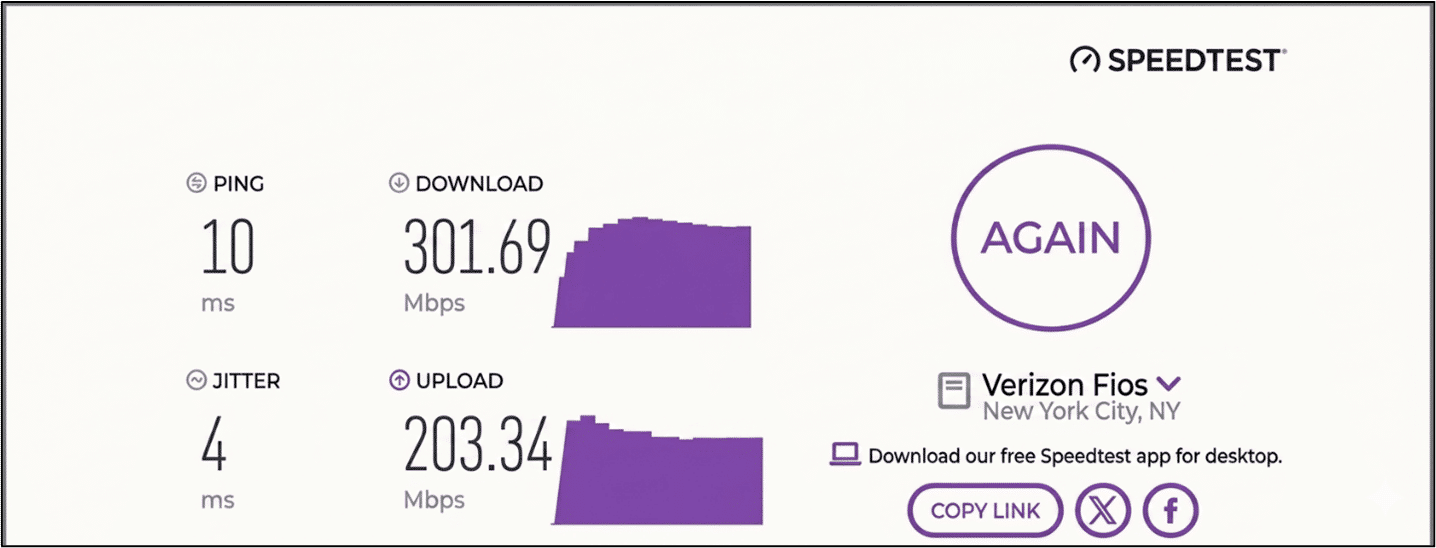
A verified speed test result from a Verizon Fios user in New York City shows strong download speeds that are more than enough for 4K streaming, remote work, and multiple devices running at the same time. Ping staying low still makes Fios a reliable option for multitasking across busy NYC households.
See How Fast Your Connection Really IsLow-Cost Options for a Budget-Friendly Lifestyle
NYC looks prosperous on paper with a median household income of $85,974. However, with average rents scraping $4,800 a month and a stark digital divide in parts of the Bronx and other underserved neighborhoods, where over a third of households lack broadband, finding a low-cost internet connection is a financial necessity. Balancing high density and tight budgets means securing a plan that keeps you online without eating into your grocery fund. Here are some of the best options.
By bundling a modem and removing data caps entirely, Spectrum Internet effectively neutralizes hidden variable expenses while promising multi-gig speeds. It represents the most predictable financial option for multi-user spaces requiring an uninterrupted downloading volume.
EarthLink offers some of the cleanest flat-rate pricing structures in the city. While they run on multiple infrastructure types, including 5G Home, their introductory fiber plans provide amazing everyday web access with zero data throttling.
This provider offers an incredibly cheap route if your building has limited wired internet options. Verizon 5G brings competitive high-speed wireless straight to your desktop.
Pro-Tip: Under the historic New York State Affordable Broadband Act, major providers are legally required to offer qualifying low-income households (such as those on SNAP, Medicaid, or SSI) high-speed connections. If you qualify, programs like Spectrum Internet Assist or the Verizon Forward discount ensure your household stays securely connected. Furthermore, if you reside in a subsidized NYCHA housing site, check your eligibility for Big Apple Connect, which delivers entirely free broadband through 2028.
Our goal at LocalCableDeals is to make your search for the ideal internet provider a breeze. Our team has developed these FREE, easy-to-use tools to help you find the perfect plan for your needs within minutes.
Evaluate NYC’s top internet service providers. Instantly compare introductory prices, contract rules, and promotional perks to ensure your home office or creative studio has the exact uploading power needed to keep up with the city's intense hybrid work standards.
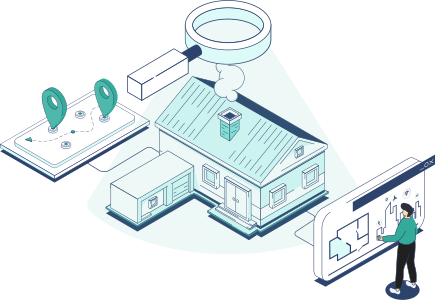
Compare ProvidersEvery single apartment building in the five boroughs has a completely different digital footprint. Our Plan Builder filters through local infrastructure and building monopolies to find the exact bandwidth requirements for your specific household budget.
Build a PlanRun a quick diagnostic to find out if your current connection is actually delivering what you pay for. Verify your real-time upload and download speeds to ensure your apartment can handle multiple simultaneous 4K video streams, heavy cloud file transfers, and lag-free video calls without a fight.
Test my SpeedBrowse internet options, speeds, and coverage in other cities of New York to get a complete picture.
Even though Verizon Fios manages a dominant residential fiber footprint across the New York City, availability remains an address-specific solution. The structural bottleneck is the bureaucracy of property owners. Availability often depends on whether fiber infrastructure has been installed in your building and whether the property owner has approved access for providers.
If maximum network capacity is your top priority, Optimum Fiber leads the NYC market with its top-tier 8 Gbps residential service. Verizon Fios represents the closest citywide alternative, providing 2 Gbps connections built on dedicated fiber strands. Opting for either of these top fiber tiers means you will hardly ever experience lag, even during the city's peak streaming hours.
If both options are fully wired to your building, your decision comes down to a preference for pure network stability versus widespread cable bundling. Verizon Fios is generally considered the premier choice for New Yorkers due to its 100% fiber infrastructure and impressive symmetrical speeds. However, Spectrum is highly compelling if you want a flexible, contract-free hybrid fiber-coaxial plan that seamlessly bundles with a free year of unlimited mobile service.
Give us a call. We'll help you find the right answers.
(855) 771-3154Available Monday through Sunday, 24 Hours a Day.
All trademarks belong to their respective owners and are used for informational purposes only. This website uses Microsoft Clarity to understand user interactions and improve products and advertising.
© Copyright 2026 LocalCableDeals. Powered by ibex. All rights reserved.
View our Privacy Policy.

















 Provider Comparison
 Plan Builder
 Speed Test