$24.95/mo.
300 Mbps
25–150Mbps
$39.99/mo.
100 Mbps
As the second-largest metro in New York State, Buffalo is home to more than 270,000 people, which mainly include students, healthcare workers, blue-collar professionals, and the growing remote workforce. But it’s the latest high-tech shift in the city that’s actually turning heads.
With significant growth in the digital and healthcare sector (looking at increasing high-tech startups and firms in Seneca One Tower and Medical Campus expansion), Buffalo is now more reliant on high-speed and reliable internet options for remote work, gaming, streaming, and everything in between.
While Spectrum was the most popular option for the longest time, Buffalo residents now have far more choices when it comes to internet providers. Currently, it is a competitive market for various fiber and wireless providers that are expanding their presence across most of the city.
Despite the growing competition, . If you’re a University at Buffalo or Buffalo State student moving into an off-campus apartment, Spectrum is usually your first call because of its no-contract flexibility and the fact that they’re already wired into almost every triple-decker in the city.
For Buffalo’s growing remote workforce, Verizon is the name everyone is chasing. While their 5G Home Internet is popping up everywhere as a quick-setup favorite for West Side renters (competing closely with T-Mobile’s wireless footprint), the real prize is Verizon Fios. It’s the ideal choice if you prioritize symmetrical speeds and no data caps. However, it’s still a bit of a geographic lottery since Fios is only available in select neighborhoods at the moment.
City residents are keeping a close eye on expansion from newer local players like Greenlight Networks and Fastbridge Fiber to see who hits their block first.
EarthLink Fiber has also become the go-to alternative for those who want gigabit-plus performance and the peace that comes with a 24-Month Price Guarantee, without the cable headaches. Thanks to fiber partnerships, they’ve managed to cover about half the city, offering symmetrical speeds and no data caps.
They are a key part of the new Buffalo infrastructure that brands like Future Fiber are also aiming to build upon.
When you head out toward the rural edges of Erie County into Eden or Marilla, the wires often run out. This is where Starlink has become a real game-changer, offering a high-speed orbital lifeline that traditional satellites just can't touch.
Hughesnet and Viasat still hold the line for those who need a budget-friendly or basic connection in the farthest corners of the county, but in a city as dense as Buffalo, they remain the last options when the grid ends.
By matching your neighborhood to the right internet provider, you can make sure your house stays online, regardless of how thick the snow gets.
322.29 Mbps
26.00 Mbps
17 ms
17
Average speed rate as per Ookla’s Speedtest results for 2026
Enter your zip code to get a complete list of internet providers serving your neighborhood. Compare speeds, prices, features, and plans, and select the best option for your home.
Fiber internet uses fiber optic cables to deliver symmetrical speeds, ensuring a smooth experience in Western New York. Fiber is immune to the electromagnetic interference that affect older wiring during heavy storms, but it is currently only available in select areas.
Best for:Cable internet delivers asymmetric speeds via coaxial cables, offering dependable connectivity and wide coverage across Buffalo. Despite high download speeds, it typically features slower uploads. The biggest strength in the 716 is its pre-existing infrastructure.
Best for:This fixed wireless tech uses local cell towers to provide internet for your home. The DIY setup bypasses old building wiring. It is highly flexible, though speeds can vary depending on your proximity and neighborhood density.
Best for:While remote workers in Allentown and the Medical Campus still largely rely on established cable networks, the "Queen City of the Lakes" is undergoing a state-backed infrastructure overhaul.
At the same time, the Erie County is laying the groundwork for ErieNet, a 400-mile open-access fiber backbone that began construction in late 2024. Beyond faster streaming, these projects are designed to bypass aging 20th-century wiring and ensure that every neighborhood has the reliability needed for 24/7 telehealth and remote work.
If you’re lucky enough to live in an area where the fiber lines have already been laid (including much of the Northtowns or the newer residential pockets Downtown), investing in a fiber connection is the ultimate home upgrade. Providers like Verizon Fios and EarthLink lead the charge with symmetrical speeds up to (and EarthLink reaching up to 5 Gbps in select spots).
Cable is the undisputed backbone of the Queen City, reaching majority of the metro area from the First Ward to North Buffalo. Spectrum Internet, with its multi-gig speed, continues to cater to local internet needs because its lines are already integrated into the city’s housing stock. While fiber continues its steady expansion, Spectrum remains the most reliable high-speed option for the majority of residents who can't yet get a fiber drop at their doorstep.
Fixed wireless is having a significant moment in Buffalo, especially among the UB and Buffalo State student populations in University Heights and Elmwood. Verizon 5G Home offers a simple plug-and-play setup that eliminates the need for a technician. Without a long-term contract and flat monthly rates, these 5G services offering speeds of up to 300 Mbps are perfect for mobile professionals and students.
As you move toward the outskirts and remote regions, the wired grid can get spotty. Starlink has become the go-to for residents who want a modern and high-speed internet with lower-latency performance.
$30/mo.
100 Mbps
For 1 year. for terms and conditions.
$24.95/mo.
300 Mbps
For the first 3 Months. $49.95 starting Month 4. Pricing shown is for select markets only. Availability and speeds vary by location.
$30/mo.
300 Mbps*
Plans start at $30/mo for Fios 300 Mbps or $35/mo for 5G Home Internet with any Verizon mobile phone plan. Plan prices require Auto Pay.
Connectivity requirements in the Queen City are as varied as its neighborhoods, ranging from the historic streets of Elmwood Village to the more tech-oriented Buffalo Niagara Medical Campus.
For a software engineer or data scientist working from a home office in North Buffalo, reliable bandwidth is non-negotiable. These professionals typically require at least 300 to 500 Mbps of symmetrical speeds. Verizon Fios offers fiber-to-the-home connections that ensure upload speeds match download speeds, which is critical for those pushing massive amounts of data to remote servers.
With the Buffalo Niagara Medical Campus and the University at Buffalo driving much of the local economy, medical professionals and researchers often bring their work home. These users benefit from high-capacity fiber infrastructure provided by both EarthLink and Verizon Fios.
Even regular use in large households now requires at least a 1 Gbps tier, which is perfectly served by Spectrum Internet. While one person streams a lecture, another can binge-watch on Netflix without any hassle. Spectrum’s wide availability across Buffalo makes it a go-to for those who need high download speeds and easy setups to keep the entire house connected.
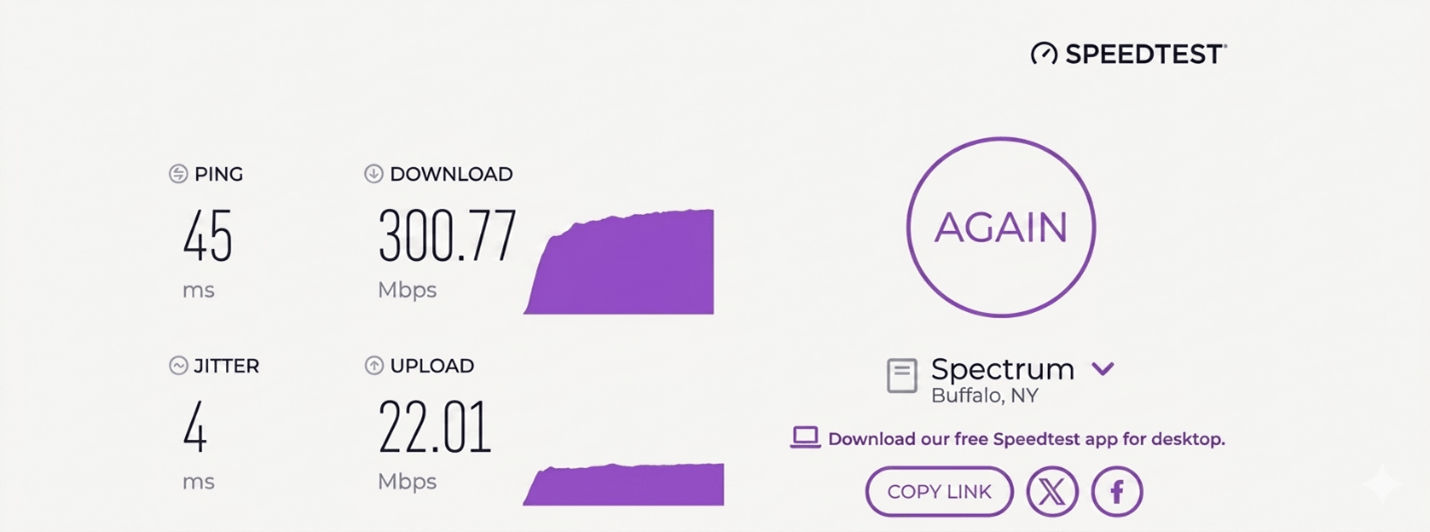
A verified speed test result from a Spectrum Internet user in Buffalo, NY, shows a healthy connection with decent downstream, good enough for 4K streaming, and cable-typical, slightly underwhelming upstream. Ping is less than 50 ms, making it ideal for multi-device streaming.
See How Fast Your Connection Really IsLow-Cost Options for a High-Cost City
With , many are prioritizing monthly savings over multi-gig hype. While the lake-effect winters can send heating costs through the roof, choosing the right internet service in Buffalo is one of the few ways to actually keep your household budget predictable. You can secure a better rate by choosing these value-focused plans from leading Internet Service Providers (ISPs) in Buffalo:
As the city's most widely available provider, Spectrum often leads with the lowest starting rates to get you in the door. For many UB and Buffalo State students in the Heights, Spectrum no-contract plans are the easiest way to get online fast without a massive deposit.
Verizon Fios & 5G Home: Verizon is a local favorite for budget-conscious homeowners because they often bundle the equipment costs directly into the monthly price. If you’re already a Verizon mobile user, you can often slash your home internet bill significantly.
EarthLink provides a high-speed alternative for Allentown and Elmwood Village residents who want fiber reliability without the premium price tag.
Pro-Tip: Residents in the West Side (14213) and East Side (14211, 14212) can significantly lower their digital expenses by qualifying for state-mandated low-cost programs. Under New York’s Affordable Broadband Act, large providers must offer affordable, high-speed plans for qualifying households. Programs like Spectrum Internet Assist and Verizon Forward also serve as critical lifelines for local families and seniors on a fixed income.
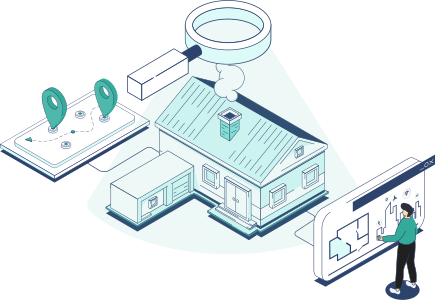
Our goal at LocalCableDeals is to make your search for the ideal internet provider a breeze. Our team has developed four FREE, easy-to-use tools, designed to help you find the perfect plan for your needs within minutes.
Evaluate prominent Buffalo ISPs like Spectrum and Verizon Fios side-by-side based on pricing, speeds offered, best features, and storm-season reliability to find your best match.
Compare ProvidersGet recommendations tailored to your household size and usage habits, whether you’re a student at the University at Buffalo or a remote worker in the Queen City.
Build a PlanCheck if your current internet provider is delivering the promised download and upload speeds to meet your household or home office needs by running a quick test.
Test my SpeedBrowse internet options, speeds, and coverage in other cities of New York to get a complete picture.
Yes, fiber is expanding rapidly across the city. EarthLink Fiber and Verizon Fios are the two primary providers, with EarthLink currently covering approx. 50% of the city through its partner networks.
Currently, EarthLink Fiber holds the crown for fastest speed in Buffalo, offering plans up to 5 Gbps. This is nearly double the top speeds of traditional cable for households with a dozen connected devices. If fiber hasn't hit your specific block yet, Spectrum remains the best choice with download speeds up to 2 Gbps across almost the entire city.
Fiber (Verizon Fios or EarthLink) is the clear winner. The reason isn't just the download speed. It's also the symmetrical upload speeds. This means your video calls stay crystal clear and your large file transfers don't crawl, even if the rest of the house is streaming the Sabres game.
Fiber-optic lines are the most weather-proof because they use light instead of electricity, which makes them immune to the moisture and interference that can plague older copper cable lines in case of a heavy storm. Satellite (Starlink/Hughesnet/Viasat) can be affected by heavy snowfall, and 5G Home Internet can occasionally see minor fluctuations during extreme weather, but for the most part, wired fiber is your best bet for staying online when the city is shut down.
Give us a call. We'll help you find the right answers.
(855) 771-3154Available Monday through Sunday, 24 Hours a Day.
All trademarks belong to their respective owners and are used for informational purposes only. This website uses Microsoft Clarity to understand user interactions and improve products and advertising.
© Copyright 2026 LocalCableDeals. Powered by ibex. All rights reserved.
View our Privacy Policy.













 Provider Comparison
 Plan Builder
 Speed Test