$60/mo.
300Mbps
$30/mo.
300 Mbps
$24.95/mo.
300 Mbps
30/mo.
300 Mbps
25–150Mbps
$39.99/mo.
100 Mbps
Baltimore has one of the densest rowhomes on the East Coast, and a cybersecurity and healthcare workforce that logs serious remote hours. Every neighborhood comes with its own "main character energy" in this region. Internet availability, however, varies by area. A plan that works in Canton might not be available two miles west in Mondawin.
The best internet for you depends on where you live in Baltimore.
Verizon's fiber offering is the go-to choice if you can get it. It has equal upload and download speeds and no data limits. But it's only in a few areas, like Druid Hill Park, Medfield, and near Johns Hopkins. EarthLink Fiber is another good fiber choice offering similar speeds.
Most people in Baltimore will use cable or HFC instead. Xfinity covers most of the city and offers speeds up to 2 Gbps. Spectrum covers the rest, and you don't need a contract, which makes it a suitable option for renters.
In case you prioritize an internet connection that's easy to set up, look for 5G home internet options from Verizon, EarthLink, and AT&T that only require a simple plug-in. No drilling needed.
Astound Broadband covers some areas too. Check as per your zip code to find out if you're eligible. And satellite options like Starlink, Hughesnet, and Viasat work almost anywhere as a backup option.
236.04 Mbps
41.67 Mbps
14 ms
22
Average speed rate as per Ookla’s Speedtest results for 2026
Enter your zip code to get a complete list of internet providers serving your neighborhood. Compare speeds, prices, features, and plans, and select the best option for your home.
Fiber internet sends data through thin glass wires. It delivers the fastest and most consistent speeds in Baltimore. Upload and download speeds are the same, which is great. The only downside is that it's only in a few neighborhoods.
Best for:Cable internet reaches nearly the whole city, so it's a solid option if you can't get fiber. This technology uses the same wires that are used to carry cable TV. Speeds might slow down a little when neighborhood traffic peaks.
Best for:Fixed wireless home internet uses cell towers instead of cables. There are no cables to drill or install. Just plug it in, and you're good to go. It's perfect for renters who move a lot, or anyone who wants internet set up the same day.
Best for:Baltimore has a lot of old housing, as nearly half of all homes were built before the 1940s. Because of this, cable has been the main choice for most people. But new projects are working to bring better options.
The city's Office of Broadband and Digital Equity started a plan in December 2023. It treats home internet as an essential infrastructure.
In December 2024, the mayor awarded a $2 million grant to Waves, a nonprofit internet provider. The money is bringing fiber internet to 12 low-income apartment buildings. Almost 3,000 households will get better service.
Private companies are helping too. Xfinity is the main cable provider in the city. Verizon has grown slowly inside Baltimore, though it's expanded faster in the suburbs. EarthLink Fiber now serves some of the same neighborhoods as Verizon. Astound Broadband offers wired internet in a few areas too.
Overall, internet in Baltimore is getting better. But what you can get still depends on your address.
Verizon Fios gives you the same speed for uploading and downloading, with no data limits. EarthLink offers the same, plus a 24-Month Price Guarantee. Both are only in certain neighborhoods, so check your address first.
Xfinity Internet is available to many households in Baltimore. Depending on the plan and location, customers may have access to gigabit speeds, up to 2 Gbps service, and a 5-year price guarantee with no credit check requirements. Spectrum focuses on a straightforward fiber-powered internet experience with no contracts and an included modem.
Verizon 5G Home Internet is the most compelling wireless option with up to 3-year price lock on select plans. It's also the most affordable option for any provider in the city. Setup is a simple plug-and-play. EarthLink 5G is similar in price and coverage. Both are great for people who move a lot or need internet set up fast, without any wiring.
$30/mo.
300 Mbps
w/ Auto Pay
$40/mo.
300 Mbps
For 60 mos., no term contract. Taxes and fees extra. Incl. up to $10/mo. auto-pay & paperless bill discount. See Broadband Facts: https://www.xfinity.com/broadband-labels
$49.95/mo.
400 Mbps
5G Internet speeds are not guaranteed, vary by location and device, and may be limited or slowed during network congestion.
Baltimore's city-average download speed sits below the Maryland state average, which is 295.93 Mbps. That gap doesn't mean you accept a slow connection. It's a reason to choose carefully.
Verizon Fios: Verizon Fios offers the fastest, most steady speeds in the city. Since it uses fiber, speeds don't drop like they can on shared cable networks. It's a great pick for big streaming households or people working in tech and healthcare jobs from home.
Xfinity: Xfinity can't always match fiber on speed, but it reaches far more addresses. Its gigabit plans are available in many areas, and its mid-tier plans are more than enough for most families streaming and using smart devices.
EarthLink 5G: EarthLink 5G occupies a different lane. It's the fastest wireless option in Baltimore, delivering competitive speeds without the installation requirements of fiber or cable. As for the performance, moderate users won't feel the need to upgrade.
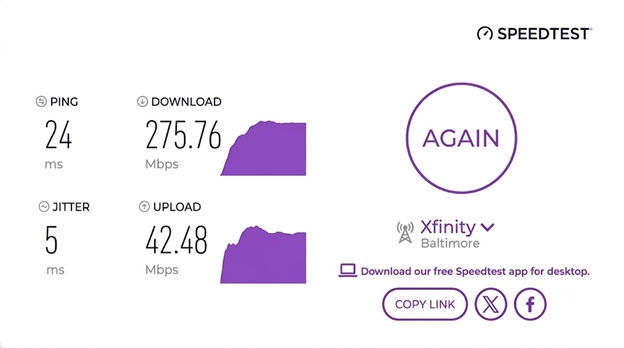
A verified speed test result from an Xfinity Internet user in Baltimore, MD, shows excellent download speeds, sufficient for 4K streaming, simultaneous video conferencing, and multi-device households. While upload speeds are lower, ping remains below 30ms, which is great for competitive gaming and real-time applications.
See How Fast Your Connection Really IsLow-Cost Options for Baltimore Residents
Baltimore's housing market and general cost of living have experienced an upward slump, making it increasingly important for Charm City families to find relief in their monthly budgets. Fortunately, keeping your home connected from Federal Hill to Northeast Baltimore doesn't have to drain your wallet. Here are your options worth considering.
Residents who qualify through SNAP, Medicaid, or SSI may access the Spectrum Internet Assist program, which provides discounted speeds for qualifying households.
Xfinity is a common low-cost option in Baltimore thanks to programs like Xfinity Internet Essentials, which serves income-qualifying households on SNAP, Medicaid, or housing assistance, with affordable plans.
This one runs on 5G Ultra Wideband where available, and comes with no equipment fees and no early termination fees. It is the lowest entry point among wired and wireless providers in Baltimore.
Pro-Tip: For low-income Baltimore households on SNAP, Medicaid, or housing assistance, Xfinity's Internet Essentials program offers plans starting at $9.95/month. The city's FreeBmoreWiFi network also provides free public Wi-Fi at recreation centers and senior facilities across Baltimore. For the most current eligibility information, visit technology.baltimorecity.gov.
Our goal at LocalCableDeals is to make your search for the ideal internet provider a breeze. Our team has developed FREE, easy-to-use tools designed to help you find the perfect plan for your needs within minutes.
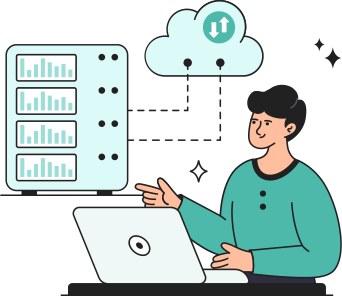
Stack Baltimore's top broadband options side-by-side. Filter by coverage area, real monthly cost, and data caps to find the plan that works for your specific neighborhood and household type.
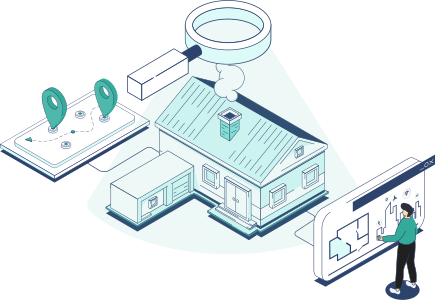
Compare ProvidersBaltimore's fiber coverage stops at neighborhood lines. Our Plan Builder checks your exact address against active provider networks to build the right plan for your block, and not just your zip code.
Build a PlanBaltimore's citywide average download speed trails both Maryland and national benchmarks. Run a diagnostic to see if your current connection is actually delivering what you're paying for.
Test my SpeedBrowse internet options, speeds, and coverage in other cities of Maryland to get a complete picture.
It depends on your address. If Verizon Fios reaches your address, it's the fastest and most reliable choice. Xfinity offers the widest coverage and the most plan choices across the city.
Yes, fiber internet is available in parts of Baltimore, but coverage is limited. Verizon Fios and EarthLink Fiber are the two primary residential fiber providers. The city's suburbs have significantly better fiber coverage, but Baltimore remains primarily served by cable.
Xfinity has the broadest internet coverage in Baltimore, reaching above 95% of the city. This factor alone makes it the most consistently available wired provider across all of Baltimore's neighborhoods. Verizon 5G Home Internet serves the city as the leading wireless option.
A good baseline for most Baltimore households is 300 Mbps. At that speed, a family can stream 4K on two screens and handle a few smart home devices without noticeable slowdowns. Students and remote professionals in shared houses should plan for at least 400–500 Mbps to avoid congestion.
Give us a call. We'll help you find the right answers.
(855) 771-3154Available Monday through Sunday, 24 Hours a Day.
All trademarks belong to their respective owners and are used for informational purposes only. This website uses Microsoft Clarity to understand user interactions and improve products and advertising.
© Copyright 2026 LocalCableDeals. Powered by ibex. All rights reserved.
View our Privacy Policy.











 Provider Comparison
 Plan Builder
 Speed Test