$24.95/mo.
300 Mbps
$35/mo.
300 Mbps*
25–150Mbps
Auburn features a fiercely contested broadband market with a growing fiber footprint expanding into new subdivisions. Traditional cable maintains broad coverage across neighborhoods and campus apartments, while wireless and satellite alternatives serve transient renters and remote outer areas, respectively.
Auburn is a place where city identity and university life intertwine closely. Thousands of students make up a massive portion of the local population, meaning stadium capacities dwarf neighborhoods and network congestion becomes a daily reality when everyone logs on simultaneously.
Finding reliable connectivity depends entirely on your exact address. Fiber options from providers like AT&T and EarthLink expand continuously across newer subdivisions and neighborhoods, delivering robust performance.
Meanwhile, hybrid fiber-coaxial networks from Spectrum and WOW! internet maintain broad coverage, ensuring most apartments near campus remain easily serviceable.
For students cycling through annual leases, wireless home internet options like Verizon, AT&T Internet Air, and T-Mobile bypass complex technician installations entirely.
Past the outer edges toward rural tracts, satellite providers such as Viasat, Hughesnet, and Starlink fill the gaps where physical lines never reached.
Ultimately, the local broadband landscape remains fiercely competitive as growing neighborhood developments continuously drive new infrastructure builds across the entire region.
366.81 Mbps
39.62 Mbps
12 ms
12
Average speed rate as per Ookla’s Speedtest results for 2026
Enter your zip code to get a list of the best internet providers serving your neighborhood. Compare speeds, prices, features, and plans, and select the best option for your home.
Fiber has spread unevenly across Auburn, reaching newer South Auburn subdivisions and stretches of the Ogletree corridor while older blocks near campus still wait their turn. Where it is live, uploads match downloads exactly.
Best for:Cable is Auburn's workhorse, reaching the large majority of addresses from downtown apartments out through Moores Mill and the Donahue Drive corridor. It turns on quickly, which matters on an August weekend when half the city changes address at once.
Best for:5G home internet covers most of Auburn's built-up grid, riding towers that already blanket campus and the South College corridor. There is no technician appointment and no long contract, which suits a rental market that turns over every spring.
Best for:Top internet providers in Alabama serve Auburn. Downtown apartment blocks rely heavily on cable and wireless technology because old buildings require quick activation without complex technician visits.
Larger homes in suburban areas depend on wireless and fiber networks to handle heavy daily household usage.
Moving outward past the city limits toward rural county roads, traditional cable infrastructure disappears completely, leaving satellite services as the primary choice for remote addresses.
Fortunately, broader state-level fiber infrastructure projects continue expanding across the entire region to improve local access.
Increasing network competition means shorter contract terms, fewer upfront installation fees, and flexible service agreements that easily accommodate annual leases without penalizing tenants who move out before summer begins.
AT&T internet leads here without much argument. Symmetrical speeds at qualifying addresses, and the footprint keeps widening through South Auburn and the newer builds off Ogletree Road.
EarthLink Fiber runs over that same infrastructure with flat-rate pricing and no annual contract, which is the better shape for a lease that ends in May. Southern Telecom's regional fiber sits underneath much of this market as carrier-grade infrastructure rather than a plan a household orders directly.
WOW! internet has served Auburn since its Knology days and still reaches a wide share of the city, with gig-class tiers available across most of that footprint.
Spectrum covers the large majority of Auburn addresses, offers internet deals, and bundles the modem with no data caps and no contract. For an apartment near Toomer's Corner or a house off Donahue Drive, either one is an easy win on move-in weekend.
T-Mobile has the stronger Auburn footprint of the two, with a receiver you can position yourself and a rate that stays put. Verizon 5G Home Internet is capacity-gated in this market, so availability shifts address by address rather than neighborhood by neighborhood.
Both skip the technician appointment entirely, which is exactly why they keep winning the August scramble when thousands of leases turn over at once.
$50/mo.
300 Mbps
Price + taxes & fees for new customers after discounts w/elig AutoPay & Paperless bill. Ltd. avail/areas.
$30/mo.
100 Mbps
For 1 year. for terms and conditions.
$35/mo.
300 Mbps*
w/ Auto Pay & any Verizon mobile phone plan .
*Typical speeds of 85-250 Mbps
Auburn's internet needs shift drastically by season and location. AT&T Fiber leads the top speed tier, reaching gig speeds in newer South Auburn areas and near Ogletree Road.
WOW! and Spectrum Internet deliver gig-class downloads across wider parts of the city, including older neighborhoods near campus.
Beyond the wired network, Starlink offers the fastest satellite speeds, alongside Hughesnet and Viasat serving rural addresses.
Choosing the right option depends heavily on your specific needs and lease terms. Engineering students handling large datasets require fiber connections with matching upload speeds.
Families managing multiple household streams thrive on gig cable tiers, and students on nine-month leases off Donahue Drive benefit most from Verizon 5G Home Internet for its easy setup and flexibility when leaving.
Ultimately, your choice should match both your bandwidth requirements and your exact lease length to ensure seamless connectivity throughout the academic year.
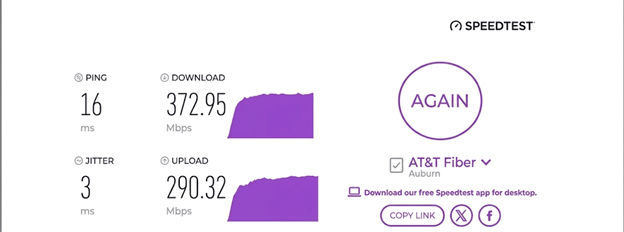
A verified speed test result from an AT&T Fiber user in Auburn, AL, shows consistently symmetrical download and upload speeds that hold steady even during Auburn University's peak evening hours — exactly what shared student households need when everyone's online at once.
See How Fast Your Connection Really IsPlans Built for Lease-Length Living
Auburn's median gross rent runs about $1,159, and renter households here bring in a median of roughly $25,112, a rent-to-income ratio north of 50 percent. While you can't control inflation, you can save by choosing cheaper internet plans in Auburn.
Spectrum's entry-tier plan includes the modem and runs without data caps or a contract. For a two-bedroom near campus splitting the bill four ways, that sits close to the floor for wired service in Auburn.
WOW! competes directly on the low end, with promotional tiers that undercut on price and a footprint reaching much of the older Auburn grid where students actually rent. Autopay enrollment shaves a few more dollars off the monthly rate.
T-Mobile folds equipment into a flat monthly rate with no installation fee, no annual agreement, and existing mobile customers usually see it drop further. Across a nine-month lease, that math is hard to argue with.
Pro-Tip: In 36830 and 36832, check Lifeline before signing anything; the federal benefit takes up to $9.25 off qualifying monthly bills, and Alabama residents apply through the National Verifier. Spectrum Internet Assist and comparable provider low-income tiers cover households with a student on free or reduced lunch or on SNAP, often with no equipment fee and no credit check.
Our goal at LocalCableDeals is to make your search for the ideal internet provider a breeze. Our team has developed FREE, easy-to-use tools designed to help you find the perfect plan for your needs within minutes.
Line up AT&T Fiber against Spectrum and WOW! at your specific Auburn address, filtered for what renters actually care about — contract length, equipment fees, and whether the promotional rate survives past the first year of the lease.
Compare ProvidersTell it whether you're a student splitting a downtown apartment, a household in Moores Mill running several streams at once, or a remote worker who needs real upload speed, and it maps that to the Auburn plans that fit.
Build a PlanCheck if your current Auburn provider is delivering the promised download and upload speeds to meet your household or home office needs by running a quick test.
Test my SpeedBrowse internet options, speeds, and coverage in other cities of Alabama to get a complete picture.
AT&T Fiber and EarthLink Fiber provide expansive coverage in newer South Auburn and Ogletree Road, reaching up to 5 Gig. Older campus blocks remain cable territory. Because third-party coverage estimates vary widely, residents should verify availability directly by their exact address.
Spectrum offers affordable no-contract wired service with a modem included, while WOW! provides competitive promotional pricing across older neighborhoods. Verizon eliminates setup fees for short leases, and households in specific zip codes should verify Lifeline program eligibility beforehand.
For short leases ending in May, flexibility beats speed. T-Mobile and Verizon 5G avoid technician appointments and annual contracts during August turnover. Downtown roommates often choose Spectrum's no-contract wired tier, while graduate students uploading large files require fiber connections.
AT&T Fiber offers symmetrical connections at qualifying locations, while WOW! provides multi-gig tiers across a narrower area. Spectrum delivers widespread coverage up to one gigabit. Ultimately, the fastest available neighborhood option differs from the citywide maximum.
Give us a call. We'll help you find the right answers.
(855) 771-3154Available Monday through Sunday, 24 Hours a Day.
All trademarks belong to their respective owners and are used for informational purposes only. This website uses Microsoft Clarity to understand user interactions and improve products and advertising.
© Copyright 2026 LocalCableDeals. Powered by ibex. All rights reserved.
View our Privacy Policy.
















 Provider Comparison
 Plan Builder
 Speed Test