$60/mo.
300Mbps
$35/mo.
300 Mbps*
25–150Mbps
Reading relies heavily on widespread cable infrastructure serving nearly all neighborhoods, while symmetrical fiber reaches roughly one-third of the city. Wireless home options provide flexible, non-invasive alternatives for the majority-renter population, and satellite fills remaining gaps as competing networks expand to deliver dependable connections.
Reading's residential internet landscape is defined by competing network architectures across the community. Most local households sit on Xfinity's extensive cable infrastructure, which covers nearly every neighborhood from Centre Park and Callowhill out toward Hampden Heights, establishing it as a default utility.
Meanwhile, locally built FastBridge Fiber reaches roughly one-third of the city and continues expanding through the west and northeast.
A substantial portion of the city's network now operates wirelessly; T-Mobile, AT&T, and Verizon provide broad cellular coverage without requiring technician visits or drilled walls, an essential advantage in a city where roughly 59 percent of homes are renter-occupied.
For locations where ground-based infrastructure falls short, satellite providers like Starlink and Viasat serve as options of last resort.
As fixed wireless gains ground and fiber expands, traditional cable faces mounting competition to deliver dependable everyday connections.
298.17 Mbps
71.41 Mbps
29 ms
15
Average speed rate as per Ookla’s Speedtest results for 2026
Enter your zip code to get a list of best internet providers serving your neighborhood. Compare speeds, prices, features, and plans, and select the best option for your home.
Cable is the closest thing Reading has to universal service, reaching almost every address across the city grid. Speeds climb well past what a typical household consumes, though the upload path stays narrow and evening congestion can show in the densest blocks.
Best for:Fixed wireless arrives over the same towers that carry phone traffic, so coverage follows the cellular map rather than the conduit map. Setup takes minutes, and no technician, and performance varies by distance to tower and by floor within taller buildings.
Best for:Satellite internet serves the addresses the wired and cellular grids leave thin, particularly on the outer edges toward Berks County. Latency runs higher than any terrestrial option, and the tradeoff is coverage rather than speed or price.
Best for:Reading's connectivity map divides along infrastructure lines rather than city streets. While cable underlies nearly the entire city, the primary divide is fiber internet availability, which cuts directly through neighborhoods.
Two homes on the same block in Glenside or Northmont can face entirely different choices depending on recent network builds, making citywide averages unhelpful for individual households.
Federal BEAD funding administered by the Pennsylvania Broadband Development Authority is entering deployment. The number of high-speed fiber providers in Pennsylvania are expected to increase in the coming years.
Inside the city, the most significant shift is the rapid growth of fixed wireless leveraging existing towers rather than ground trenching.
For cost-conscious residents, wireless connections that eliminate installation fees, equipment deposits, and two-year commitments significantly alter household budgeting before download specs are even evaluated.
Xfinity internet carries the cable tier in Reading with near-total reach and a speed ladder running from an entry tier suited to a single-earner household up past a gigabit. The honest comparison here is against fiber rather than against another cable operator, since none exists in the city. FastBridge Fiber beats it on upload and on customer ratings where it reaches, which is a minority of addresses.
T-Mobile holds the widest fixed-wireless footprint in Reading and prices at a flat rate with equipment included. Verizon 5G Home Internet reaches fewer addresses but competes hard where signal is strong. AT&T Internet Air rounds out the tier for households with no annual contracts.
Starlink delivers LEO connectivity, serving Reading's outer edges, which is the specification that separates a usable video call from an unusable one. Hughesnet and Viasat cost less upfront and remain reasonable where a household's needs stay modest, though both carry higher latency and tighter data policies.
$40/mo.
300 Mbps
For 60 mos., no term contract. Taxes and fees extra. Incl. up to $10/mo. auto-pay & paperless bill discount. See Broadband Facts: https://www.xfinity.com/broadband-labels
$39.99/mo.
100 Mbps
For 12 months. Minimum term required. Early service termination fees apply. Monthly Fee reflects the applied $5 savings for ACH enrollment. Offer may vary by geographic area.
$60/mo.
300Mbps
Price after $5/mo. AutoPay discount (w/in 2 bills). Paperless billing required. Monthly State Cost Recovery charge applies in OH, NV, TX.
Internet speed in Reading depends less on overall network capability and more on which infrastructure reaches a specific doorstep.
Cable Internet blankets the city, fiber delivers faster symmetrical performance across roughly a third of addresses, and wireless options reach nearly everyone while easily handling standard household tasks.
Household demands dictate the right choice. A hybrid worker along Route 222 needing a dependable connection for scheduling and calls is well served by entry-tier service from Xfinity or flat-rate wireless from T-Mobile.
In Riverside, a home with multiple remote workers and evening streaming has a stronger need for mid-tier cable with solid upload capacity.
Meanwhile, off-campus college students are typically better off with no-installation alternatives like Verizon 5G Home Internet over long-term contracts. Ultimately, the ideal connection is the one matching daily household routines rather than the specification sheet.
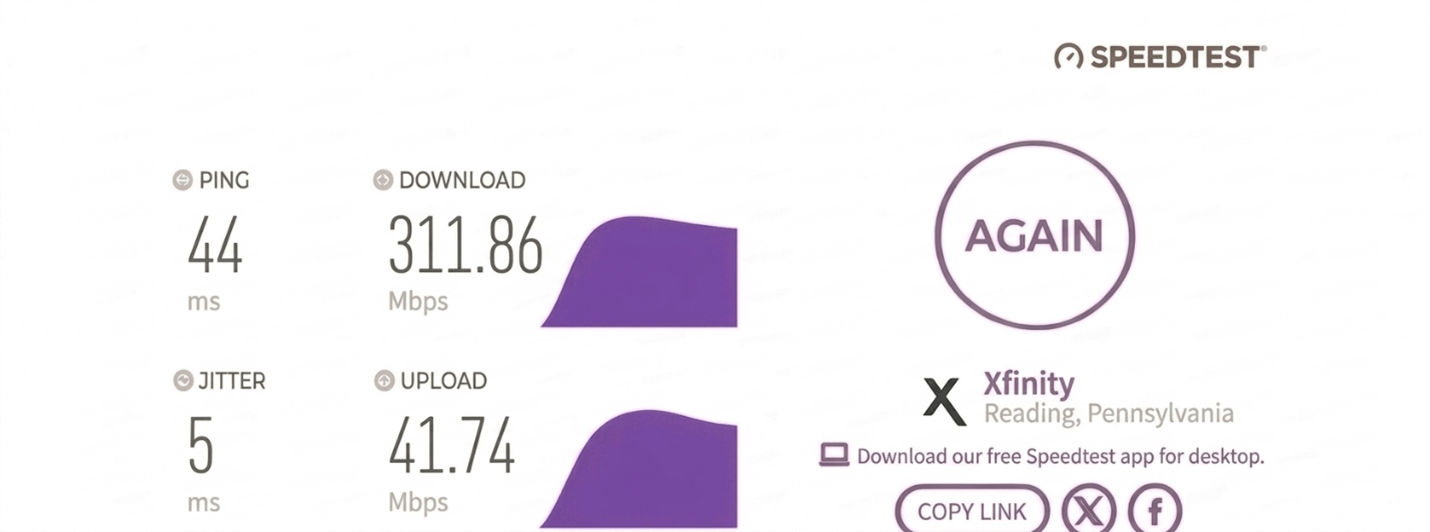
A verified speed test result from an Xfinity user in Reading, PA shows consistent download performance well above the plan's advertised baseline speed - the kind of reliable throughput that keeps a South Side family's multi-device household running smoothly through peak evening hours without throttling or buffering.
See How Fast Your Connection Really IsDependable Service on a Working Budget
Reading's median household income of $44,091 is near half the Pennsylvania figure, and better than a quarter of residents live below the poverty line. While you cannot control inflation, you can save by choosing cheaper internet plans in Reading.
Xfinity holds the lowest entry pricing among the city's wired options and pairs it with Internet Essentials, a qualifying-household tier that includes the gateway rather than billing it separately as a monthly rental line.
T-Mobile prices at one flat monthly figure with equipment and taxes folded in, no installation charge, and no annual commitment, which suits households that have been surprised by a second-year increase before and would rather know the real figure at signup.
Verizon 5G Home Internet sits in similar territory and layers Verizon Forward on top, cutting the monthly figure further for households already enrolled in a qualifying federal assistance program such as SNAP or Medicaid.
Pro-Tip: Households in 19601 and 19604 sit inside the densest concentration of qualifying addresses in Berks County. Xfinity Internet Essentials runs near $14.95 monthly for eligible households with no credit check, no activation fee, and no equipment rental. Federal Lifeline adds a separate monthly discount for households at or below 135 percent of the poverty guidelines, and the two can often be layered. FastBridge Fiber, where available, also prices competitively.
Our goal at LocalCableDeals is to make your search for the ideal internet provider a breeze. Our team has developed FREE, easy-to-use tools designed to help you find the perfect plan for your needs within minutes.
Place Xfinity against T-Mobile side by side on the figures that matter to a Reading household, including monthly cost after promotional pricing ends, equipment and gateway fees, data policies, and whether an installation appointment is required at the address at all.
Compare ProvidersAnswer a short set of questions about household size, streaming habits, and whether anyone works from home, and the builder returns plans scaled to that actual use rather than to the largest package a provider would prefer to sell into a Reading household.
Build a PlanCheck if your current Reading provider is delivering the promised download and upload speeds to meet your household or home office needs by running a quick test.
Test my SpeedBrowse internet options, speeds, and coverage in other cities of Pennsylvania to get a complete picture.
Fiber reaches roughly a third of Reading addresses, primarily concentrated in the west and northeast via local provider FastBridge Fiber. Outside these areas, Xfinity cable serves almost the entire city, making address-level checks necessary due to block-by-block coverage variations.
Xfinity Internet Essentials provides the lowest monthly cost for low-income households, while T-Mobile offers competitive flat rates without installation or equipment fees for non-qualifying residents. Long-term value depends on year-two costs rather than initial promotions as wired and wireless pricing diverges.
With 59 percent of Reading housing renter-occupied, fixed-wireless options like T-Mobile, Verizon 5G Home Internet, and AT&T Internet Air offer major value. Their flat rates, lack of annual contracts, and seamless address transfers outweigh pure speed comparisons for frequent movers.
With the ACP expired, qualifying Reading households rely on the federal Lifeline program alongside provider tiers like Xfinity Internet Essentials and AT&T Access. Meanwhile, state BEAD funding primarily targets underserved rural Berks County, leaving urban city addresses with indirect benefits.
Give us a call. We'll help you find the right answers.
(855) 771-3154Available Monday through Sunday, 24 Hours a Day.
All trademarks belong to their respective owners and are used for informational purposes only. This website uses Microsoft Clarity to understand user interactions and improve products and advertising.
© Copyright 2026 LocalCableDeals. Powered by ibex. All rights reserved.
View our Privacy Policy.












 Provider Comparison
 Plan Builder
 Speed Test