$24.95/mo.
300 Mbps
$39.99/mo.
100 Mbps
25–150Mbps
$35/mo.
300 Mbps*
Waukesha sits at the edge of Milwaukee's metro sprawl, close enough to the city to attract major providers but with enough suburban stretch to keep competition lively, and its internet market reflects that balance year-round.
Run the matchup in Waukesha, and two names sit at the top of the board: AT&T Fiber and Spectrum Internet. AT&T’s fiber lines have pushed deep into the neighborhoods east of the Fox River and out toward the Carroll University corridor. It delivers symmetrical multi-gig speeds built for the city’s growing bench of remote workers and home-office professionals.
Spectrum counters with reach, with its network covering roughly 98% of Waukesha addresses, from downtown to the subdivisions ringing Frame Park. This makes it the default for households that just want one provider that works everywhere.
Earthlink rounds out the fiber side, reselling fiber where the lines reach and offering a satellite plan for addresses that the wired networks skip. For the unplugged edges of the market, the rural fringe west toward Genesee and the lots beyond the build-out, Starlink leads on low-latency satellite. Meanwhile, Hughesnet and Viasat hold steady as fixed-location fallbacks.
Verizon 5G Home has planted its own flag here, turning a strong cellular signal into a no-installation connection for renters near the university and apartment dwellers downtown.
The trend worth watching: AT&T and Earthlink keep extending fiber outward, and every block they reach forces Spectrum to sharpen its pricing. That competition is where Waukesha households win.
375.10 Mbps
23.72 Mbps
13 ms
9
Average speed rate as per Ookla’s Speedtest results for 2026
Enter your zip code to get a complete list of internet providers serving your neighborhood. Compare speeds, prices, features, and plans, and select the best option for your home.
Waukesha’s fiber footprint has spread fast along the Fox River corridor and the established blocks near Carroll University. Symmetrical upload and download shrug off the evening bandwidth crunch that hits when a whole household logs on at once.
Best for:Cable is the workhorse that reaches nearly every Waukesha address, from downtown rowhouses to the subdivisions spreading west. Download speeds satisfy most homes, though uploads trail fiber, and the busiest blocks can slow down during peak evening demand.
Best for:5G home internet turns Waukesha’s solid cellular coverage into a wireless connection with no wires to run. Performance tracks signal strength, so it’s strongest near downtown and the denser apartment clusters and thinner on the rural western edge.
Best for:How Waukesha gets online splits cleanly along geography. In the dense core: downtown, the Les Paul–era blocks near Main Street, and the student-heavy streets around Carroll University, cable and 5G home internet dominate. Push out to the newer subdivisions near Frame Park and the developments climbing toward Pewaukee, and fiber is increasingly the first choice, especially for the engineers and remote managers.
Waukesha County’s broadband expansion grants, part of the state’s push to close gaps with help from federal BEAD dollars, have nudged providers to extend fiber into pockets that cable mapped years ago. Those dollars matter most on the rural western fringe, where satellite still fills the holes.
The payoff lands squarely with the city’s home-office professionals: more symmetrical fiber on more streets means fewer dropped calls at 7 p.m. and uploads that finally keep pace with downloads.
AT&T sits at the head of the pack on fiber in Waukesha. Its symmetrical plans scale from a few hundred Mbps to multi-gig, which is exactly what the city’s remote-work bench needs. Earthlink resells fiber where AT&T’s lines reach, giving a second option on contract terms and bundling. In a handful of newer developments, TDS Telecom has run fiber of its own.
Spectrum’s fiber-powered network reaches nearly every address in Waukesha, which makes it the safe call for homes outside the fiber map. Plans run from entry tiers fine for streaming up to gigabit downloads, with no data cap to sweat. Uploads lag fiber, so heavy creators will feel the ceiling, but for most Waukesha households, this is where the value lives.
For renters and movers who want no installation and no contract, Verizon 5G Home is the smart move where the signal is strong. It is the best near downtown and the apartment corridors by Carroll University. Pricing is flat and predictable, with no equipment fee baked in.
$35/mo.
300 Mbps
For 12 mos. Price + taxes & fees for new customers in select households after discounts w/ elig AutoPay & Paperless bill. Limited availability/areas.
See Broadband Facts: www.att.com/dapbbfacts
$30/mo.
100 Mbps
For 1 year. for terms and conditions.
$55/mo.
100 Mbps
Users on the Residential Lite plan are prioritized behind Residential and will see slower speeds during peak hours. Residential Lite is not available in all areas. See availability here.
On raw speed, Waukesha’s ceiling keeps rising, and the fastest plans cluster where fiber has landed. Multi-gig fiber tops the leaderboard; gigabit cable sits a tier below because uploads can’t keep pace; 5G home and satellite fill the gaps for addresses the wires haven’t reached.
Picture three Waukesha households. A software engineer working remotely from a home office near Frame Park pushes large code builds all day. Symmetrical multi-gig fiber from AT&T is the only plan that won’t choke the upload. A family of four in a downtown apartment streams, games, and video calls at once. Spectrum’s gigabit handles the load at a friendly price. And a household on the rural western edge gets its fastest realistic option from Starlink.
The short answer: match the plan to the work, not the headline number. Waukesha finally has enough fast options that the right fit is a choice, not a compromise.
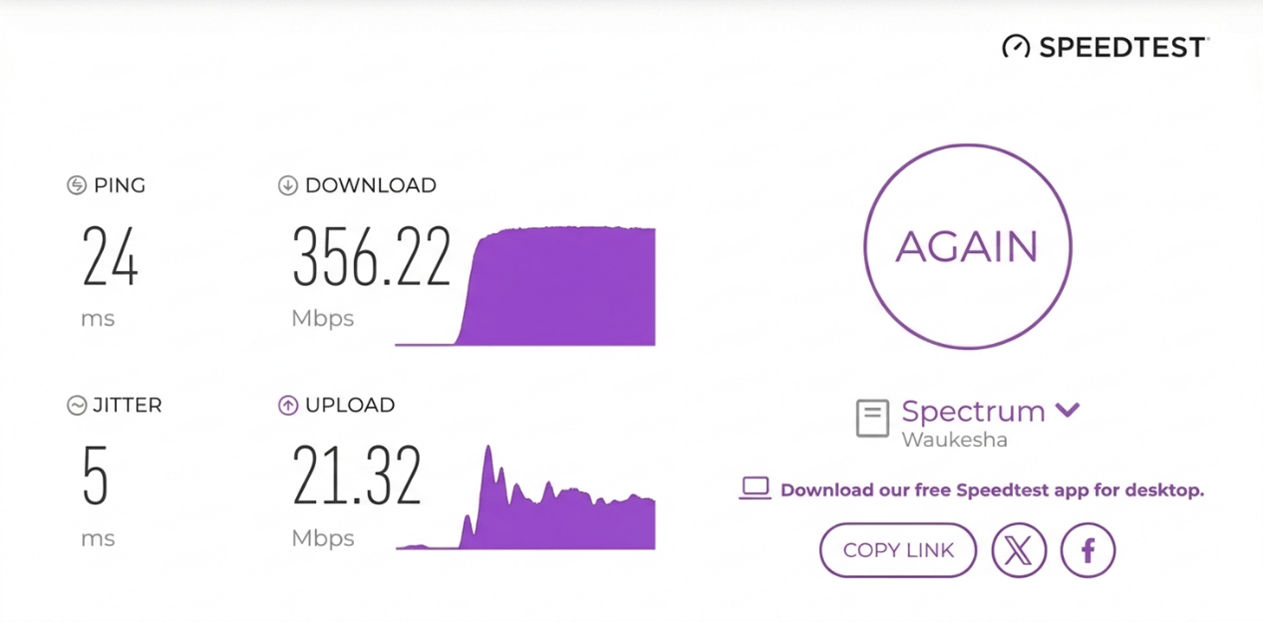
A verified speed test result from a Spectrum Internet customer in Waukesha, WI, recorded strong download performance on a recent speed test, though the notably lower upload speed reflects the asymmetrical nature of this connection type. The minimal latency and steady jitter ensure highly responsive performance for standard everyday tasks and streaming.
See How Fast Your Connection Really IsReal Speed Without the Premium Bill
Waukesha runs pricier than the Wisconsin average on housing. The median home now tops $300,000, and rents have climbed with the rest of the Milwaukee metro. A fixed internet bill is one of the few line items you can actually pin down.
Spectrum anchors the budget tier with an entry plan that’s plenty for streaming and browsing, no data caps, and a rate that holds through the promo year. It is the easy choice for cost-conscious renters citywide.
AT&T keeps fiber competitive with straightforward pricing, no equipment fee on most internet plans, and no annual contract. So, the speed premium doesn’t arrive with hidden add-ons.
Verizon 5G Home may be the cheapest path of all for a wireless household: one flat monthly rate, router included, and a deeper discount if you already carry a Verizon phone plan.
Pro-Tip: In ZIP codes 53186 and 53188, qualifying low-income households can tap Spectrum Internet Assist, a cheap plan with no data cap, no contract, and a free modem. Lifeline-eligible residents may stack additional savings, and TDS Telecom offers a low-cost tier in the pockets it serves.
Our goal at LocalCableDeals is to make finding the right Waukesha internet provider quick and painless. We’ve built free, easy-to-use tools that cut through the marketing and land you on the plan that fits your address, your speed needs, and your budget in minutes.
Stack AT&T against Spectrum side-by-side on speeds, real pricing, contract terms, and upload performance. So, the decision every remote worker cares about takes seconds instead of an afternoon.
Compare ProvidersTell us how you use the internet: a downtown apartment running three streams or a Frame Park home office pushing big uploads. The builder maps it to the right speed tier and provider for Waukesha.
Build a PlanCheck if your current Waukesha provider is delivering the promised download and upload speeds to meet your household or home office needs by running a quick test.
Test my SpeedAT&T has the widest fiber footprint in Waukesha, with symmetrical multi-gig plans live across the Fox River corridor, the Carroll University neighborhoods, and newer subdivisions toward Pewaukee. Earthlink resells fiber where those lines reach, and TDS Telecom has built fiber into select developments.
Multi-gig fiber takes the title, and AT&T leads the field with symmetrical speeds that match upload to download. Spectrum’s gigabit is the fastest widely available option where fiber hasn’t landed, strong on downloads but slower up.
For most households, Spectrum’s entry-level plan is the cheapest widely available option, with no data cap and a year-long promo rate. Qualifying low-income residents can apply for Spectrum Internet Assist and stack Lifeline credits on top.
For Waukesha’s remote-work crowd, upload speed is the deciding factor, not the download headline. AT&T fiber is the real winner here: symmetrical multi-gig means big file uploads and clean video calls even at peak hours. If fiber isn’t at your address, Spectrum gigabit handles most workloads, though heavy uploaders will feel the ceiling.
Give us a call. We'll help you find the right answers.
(855) 771-3154Available Monday through Sunday, 24 Hours a Day.
All trademarks belong to their respective owners and are used for informational purposes only. This website uses Microsoft Clarity to understand user interactions and improve products and advertising.
© Copyright 2026 LocalCableDeals. Powered by ibex. All rights reserved.
View our Privacy Policy.


















 Provider Comparison
 Plan Builder
 Speed Test