$60/mo.
300Mbps
$35/mo.
300 Mbps*
25–150Mbps
$39.99/mo.
100 Mbps
Anchorage holds close to 40% of Alaska's population in a single municipality, stretching from Downtown and Midtown out to the Hillside, Eagle River, and the military housing around Joint Base Elmendorf-Richardson.
For a city this spread out, and this dependent on steady connections through long, dark winters, the internet question is less about whether service exists and more about which type delivers reliable performance at your exact address.
Among the marketed providers here, the strongest everyday performer is AT&T Internet Air, a 5G home option reaching much of the city. Verizon 5G Home Internet competes directly on value, with introductory pricing that undercuts most wired plans.
For addresses on the edges of the bowl, stretches of the Hillside, Turnagain, and outlying Eagle River, Viasat and Hughesnet provide near-universal satellite coverage, with Viasat leaning on no-contract flexibility and Hughesnet on its low entry price.
Wired service from GCI still covers the vast majority of Anchorage households and remains the local speed benchmark, so the marketed wireless and satellite options are best read as alternatives where you want simpler setup, no-contract terms, or coverage the cable map misses.
214.14 Mbps
21.98 Mbps
13 ms
9
Average speed rate as per Ookla’s Speedtest results for 2026
Enter your zip code to get a complete list of internet providers serving your neighborhood. Compare speeds, prices, features, and plans, and select the best option for your home.
Cable reaches the widest share of Anchorage homes, covering nearly the entire municipality from Downtown south through Sand Lake and toward Eagle River. It pairs gigabit-class download speeds with the reliability of a mature, long-established network.
Best for:5G home internet has expanded quickly across Anchorage's denser cores, using cellular towers rather than buried lines. That suits a city where winter weather and terrain complicate new wired construction, and where self-installation appeals to frequent movers.
Best for:Satellite is the coverage backstop for Anchorage's edges, the Hillside benches, the Turnagain Arm corridor, and properties beyond the wired grid. Modern satellite handles streaming and browsing well, though latency and winter weather can affect peak performance.
Best for:How a household connects in Anchorage tends to track with where it sits in the bowl.
In the dense cores of Downtown, Midtown, and Spenard, most residents can choose between 5G home internet from AT&T or Verizon, and the decision often comes down to price and upload performance.
Move toward the Hillside, Stuckagain Heights, or the far edges of Eagle River and Chugiak, and the practical field narrows to fixed wireless or to satellite from Viasat and Hughesnet, where tower distance and line-of-sight matter more than the advertised tier.
Local investment is reshaping that map. Alaska Communications began rolling out fiber-fed fixed wireless to roughly 100,000 homes and businesses statewide in 2025, with Anchorage among the early markets. For Anchorage's large base of remote workers and home offices, those upgrades translate into steadier peak-hour performance, more pricing competition, and a dependable wireless alternative wherever wired speed falls short.
For fast wired service in Anchorage, GCI is among the top picks. Its cable network reaches most of the city, and its fiber network pushes symmetrical speeds into neighborhoods from South Addition to Sand Lake, making it ideal for the remote workers and smart-home households that define the local market. Alaska Communications offers fiber in select pockets as a narrower alternative.
For most Anchorage addresses inside the bowl, 5G home internet is the strongest marketed option. AT&T Internet Air leads on performance, with flat, no-contract pricing. Verizon 5G Home Internet is the value counterpart and comes with the same self-install simplicity, a natural fit for renters in Midtown and Spenard or families relocating through JBER. Both rely on cellular towers rather than buried cable, so real-world speeds depend on signal strength at your address; households that need guaranteed gigabit performance still have wired cable as the benchmark to compare against.
Where towers and cable lines run out, satellite is the reliable fallback. Viasat is the lead pick for its no-contract terms, and unlimited-data plans, suiting households that want flexibility without a long commitment. Hughesnet competes on price, with built-in price locks, a steady choice for seasonal residents and remote cabins that need dependable basic service. Neither matches fixed wireless on latency, so for video calls and gaming they work best as a coverage solution.
$60/mo.
300Mbps
Price after $5/mo. AutoPay discount (w/in 2 bills). Paperless billing required. Monthly State Cost Recovery charge applies in OH, NV, TX.
$35/mo.
300 Mbps*
w/ Auto Pay & any Verizon mobile phone plan .
*Typical speeds of 85-250 Mbps
Speeds are "up to," are not guaranteed and will vary.
Raw top-end speed in Anchorage belongs to wired networks, but the fastest option actually available at a given address increasingly comes down to which marketed service reaches it. Among those, AT&T Internet Air sets the pace, with 5G plans that cover much of the municipality.
Consider three Anchorage households. A software developer working remotely from a South Addition condo needs low latency and strong uploads. Alaska Communications and GCI handle daily video calls well, though a wired line remains the ceiling for the heaviest workloads. A family near JBER cycling through frequent moves values speed without a contract, where Verizon 5G Home Internet delivers solid multi-device performance at a lower monthly rate. And a household on the upper Hillside, past the practical edge of cable, leans on Viasat for streaming and browsing, with Hughesnet as a budget-friendly alternative when the priority is reliable coverage over peak throughput.
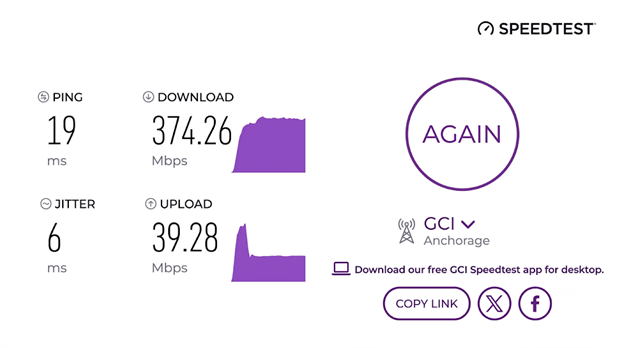
A verified speed test result from a GCI Internet user in Anchorage, AK, shows a healthy cable connection with download speeds above 300 Mbps. While upload speeds are asymmetrical, the latency is lower than 20 ms, making it ideal for multiplayer gaming.
See How Fast Your Connection Really IsStrong Performance, Without Anchorage's Usual Premium
Anchorage's cost of living runs roughly 22% above the U.S. average, and with rising home energy bills before the deep-winter spike, every recurring charge gets a hard look. While you can't control inflation, you can save by choosing cheaper internet plans in Anchorage.
Verizon is the value leader here, offering an added discount for eligible Verizon mobile customers, with no annual contract, no standard equipment fee, and a simple self-install.
Hughesnet offers the lowest satellite entry point in Anchorage, with built-in price locks that guard against mid-term hikes, making it useful for Hillside and fringe addresses with few wired choices.
Viasat keeps costs predictable with no-contract plans and unlimited data, so overages aren't a worry. It comes with built-in Wi-Fi, meaning that you get a stable internet connection with all-home connectivity.
Pro-Tip: In zip codes such as 99501 (Downtown) and 99504 (Muldoon), qualifying households can lower their bill through the federal Lifeline program, which applies a monthly discount to service from participating Alaska providers, with no activation fee or credit check required to apply.
Our goal at LocalCableDeals is to make finding the right Anchorage internet provider quick and painless. Our team built a set of FREE, easy-to-use tools that help you compare local plans, match service to your household, and confirm real-world speeds, all in a few minutes.
Line up Anchorage's marketed options side by side — weigh AT&T's speeds against Verizon's pricing, factoring in the coverage and peak-hour performance that matter most for remote work across Midtown and South Anchorage.
Compare ProvidersAnswer a few questions about your household — a multi-device home office, a no-contract rental, or a streaming-heavy family, and the Plan Builder maps your needs to the right Anchorage plan and speed tier.
Build a PlanCheck if your current Anchorage provider is delivering the promised download and upload speeds to meet your household or home office needs by running a quick test.
Test my SpeedBrowse internet options, speeds, and coverage in other cities of Alaska to get a complete picture.
Yes, but availability is uneven. Fiber in Anchorage comes mainly from Alaska Communications, with the densest coverage in neighborhoods like South Addition, Forest Park, and Broadmoor Estates, while GCI offers gigabit-class cable across most of the city. Coverage thins toward the Hillside and outlying valleys.
For raw top speed, wired cable leads the Anchorage market with providers like Alaska Communications and GCI. AT&T Internet Air is widely available, with 5G plans up to 300 Mbps and flat pricing. Verizon 5G Home Internet offers comparable everyday performance at a lower entry price.
Among Anchorage's marketed providers, Verizon 5G Home Internet is typically the cheapest, with no annual contract and an added discount for eligible Verizon mobile customers. Hughesnet is the budget satellite pick with price locks. For qualifying low-income households in zip codes like 99501 and 99504, the federal Lifeline program can further reduce the monthly cost of service from participating Alaska providers.
Anchorage's large remote-work population is best served by connections with steady uploads and low latency. Where it's available, Verizon 5G Home Internet is a strong, low-cost option for home offices in Midtown, South Anchorage, and the housing around JBER. For maximum reliability under heavy workloads, wired cable remains the benchmark, but for most home-based professionals, 5G options now offer dependable, contract-free performance.
Give us a call. We'll help you find the right answers.
(855) 771-3154Available Monday through Sunday, 24 Hours a Day.
All trademarks belong to their respective owners and are used for informational purposes only. This website uses Microsoft Clarity to understand user interactions and improve products and advertising.
© Copyright 2026 LocalCableDeals. Powered by ibex. All rights reserved.
View our Privacy Policy.













 Provider Comparison
 Plan Builder
 Speed Test